Written “I have aten breakfast already” and paused, wondering if that looks right? You’re not alone. Eaten or aten is a mistake that quietly slips into emails, essays, and casual messages, especially among English learners working through irregular verbs. The confusion makes sense – English doesn’t always follow a predictable pattern, and “eat” is one of its trickiest irregular verbs.
This guide gives you the quick answer first, then breaks down exactly why “eaten” is correct, how the verb “eat” changes across tenses, common mistakes to avoid, and simple tricks to help the right form stick for good.
Eaten or Aten :- Quick Answer
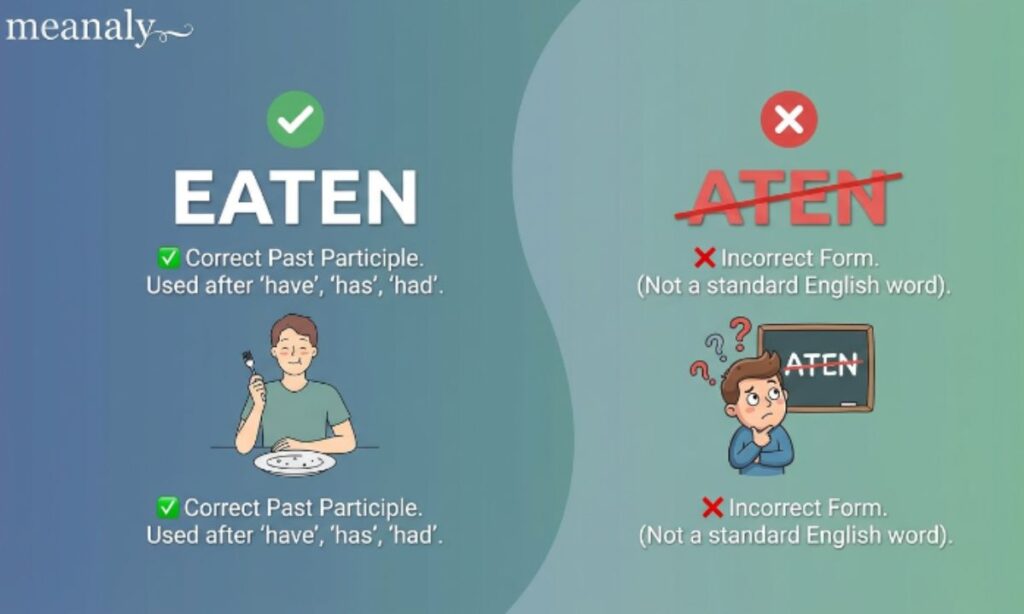
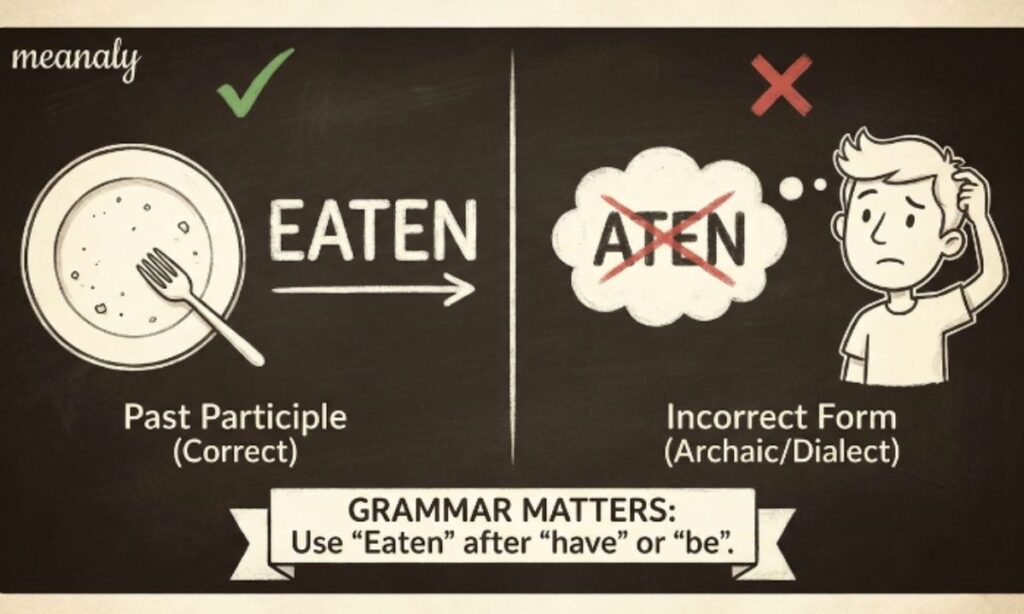
“Eaten” is correct. “Aten” is not a standard English word.
- ✅ I have eaten breakfast already.
- ❌ I have aten breakfast already.
There’s no context – formal, casual, spoken, or written – where “aten” functions as a correct verb form in English.
What Do Eaten and Aten Mean?
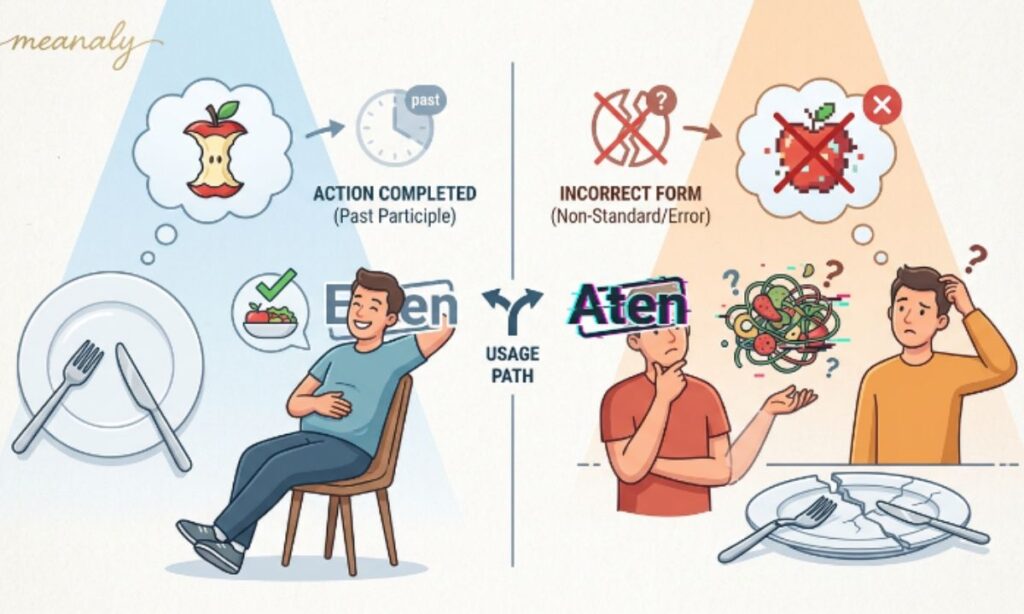
“Eaten” is the past participle of the verb “eat,” used to describe food that has already been consumed. It always pairs with a helping verb like “have,” “has,” or “had.”
“Aten” has no recognized meaning as a verb form in standard English grammar. It isn’t listed in dictionaries as a spelling variant, a dialect form, or an alternate tense – it’s simply a mistake that happens when writers try to force “eat” into a regular “-en” pattern that doesn’t apply here.
The Verb Forms of “Eat”
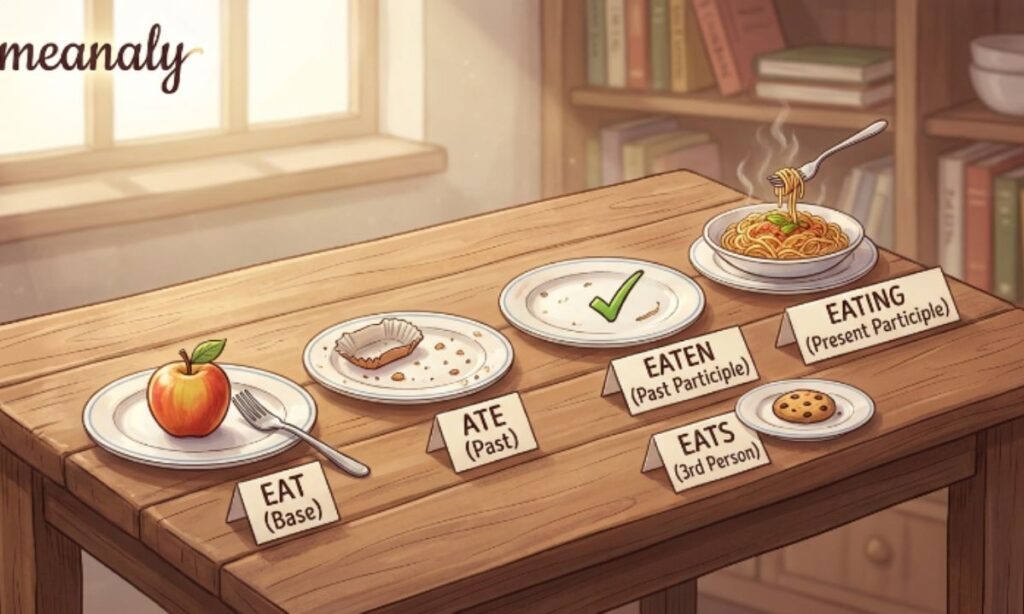
“Eat” is an irregular verb, meaning it doesn’t follow the standard “-ed” pattern. Its four main forms are:
| Form | Example |
| Base form | eat |
| Simple past | ate |
| Past participle | eaten |
| Present participle | eating |
- Simple past (ate): I ate dinner last night.
- Past participle (eaten): I have eaten dinner already.
- Present participle (eating): I am eating dinner right now.
The Origin of Eaten or Aten
“Eaten” comes from Old English etan, an irregular verb that has kept a distinct past participle form throughout the evolution of the English language. Many irregular verbs – like “give/given” and “write/written” – follow this same “-en” ending pattern for their past participle, and “eat/eaten” fits that established group.
“Aten” doesn’t come from any historical English root tied to the verb “eat.” It’s a modern spelling error, not a forgotten or regional form of the word.
British English vs American English Spelling
Some assume a spelling mismatch might come down to regional differences, similar to color/colour. That’s not the case here.
| Region | Correct Form |
| British English | Eaten |
| American English | Eaten |
| Any other English variant | Eaten |
Both varieties of English use “eaten” as the only correct past participle – there’s no accepted regional alternative.
Which Spelling Should You Use?
Always use “eaten” after helping verbs like have, has, will have, or had:
- I have eaten.
- She has eaten already.
- They had eaten before we arrived.
Common Mistakes with Eaten or Aten
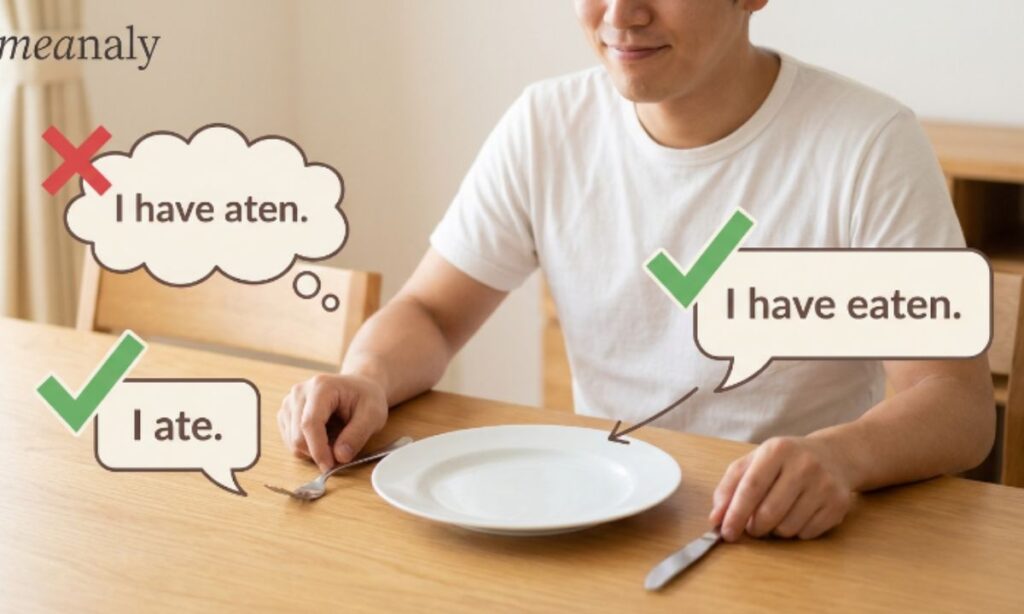
- Writing “aten” instead of “eaten” after a helping verb
- Confusing the simple past (“ate”) with the past participle (“eaten”) – e.g., saying “I have ate” instead of “I have eaten”
- Assuming irregular verbs follow the same “-en” pattern without checking the correct spelling
- Skipping the helping verb entirely, such as saying “I eaten breakfast” instead of “I have eaten breakfast”
Eaten or Aten in Everyday Examples
- I have eaten already, so I’m not hungry.
- She hasn’t eaten anything since this morning.
- We had eaten dinner before the movie started.
- The leftovers were eaten by the time I got home.
- Have you eaten yet?
Synonyms Of Eaten
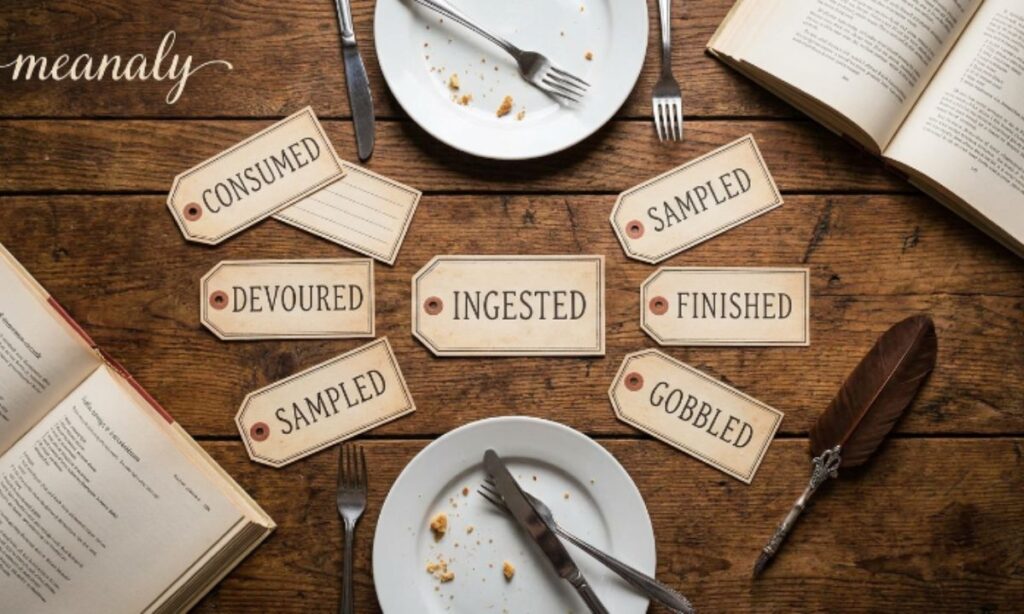
- Consumed
- Devoured
- Finished (in the context of food)
- Had (informally, e.g., “I’ve had lunch”)
- Polished off (informal)
Is Eaten A Word?
Yes. “Eaten” is a standard English word – the past participle of “eat” – and it appears in every major English dictionary as the correct form used in perfect tenses and passive voice.
How To Pronounce Eaten?
“Eaten” is pronounced EE-tn (/ˈiːtn/), with the stress on the first syllable. The second syllable is short and often blends into a soft “n” sound in natural speech.
How Do You Spell Eaten?
E-A-T-E-N. A simple way to remember it: start with “eat,” then add “-en,” the same pattern used in other irregular past participles like “give” → “given” and “take” → “taken.”
Eaten Or Aten Past Tense
To clarify a common mix-up: “eaten” is not the simple past tense – that role belongs to “ate.” “Eaten” is the past participle, used only with a helping verb.
- Simple past: I ate lunch.
- Past participle: I have eaten lunch.
“Aten” doesn’t apply to either form.
Eaten Or Aten Grammar
Grammatically, “eaten” functions as a past participle, appearing in:
- Perfect tenses: I have eaten, she had eaten, they will have eaten
- Passive voice: The cake was eaten, the food has been eaten
“Aten” has no grammatical role in English – it isn’t recognized as a verb form, noun, or adjective in standard usage.
Eaten Or Aten Examples
- Correct: He has eaten his lunch already.
- Incorrect: He has aten his lunch already.
- Correct: All the snacks were eaten by noon.
- Incorrect: All the snacks were aten by noon.
Is Aten A Word For Food?
No. “Aten” is not a word associated with food or eating in standard English. It doesn’t function as a noun, verb, or adjective related to meals or consumption – it’s simply an incorrect spelling of “eaten.”
Why Do People Get Confused Between Eaten and Aten?
- English learners sometimes assume irregular verbs follow the same “-en” pattern without adjusting the base spelling correctly
- The similarity in sound between “eat” and “aten” can cause quick typing errors
- Some irregular verbs (like “take” → “taken”) reinforce a pattern that doesn’t map perfectly onto every verb
- Autocorrect doesn’t always catch the error in casual texting or messaging apps
Eaten or Aten – Search Trends and User Intent
Search interest in “eaten or aten” comes primarily from English learners and students double-checking grammar before writing essays, messages, or assignments.
This falls squarely into informational search intent – people aren’t looking to purchase anything; they simply want a clear, quick confirmation of the correct form before they hit send or submit.
Comparison Table: Eaten vs Aten
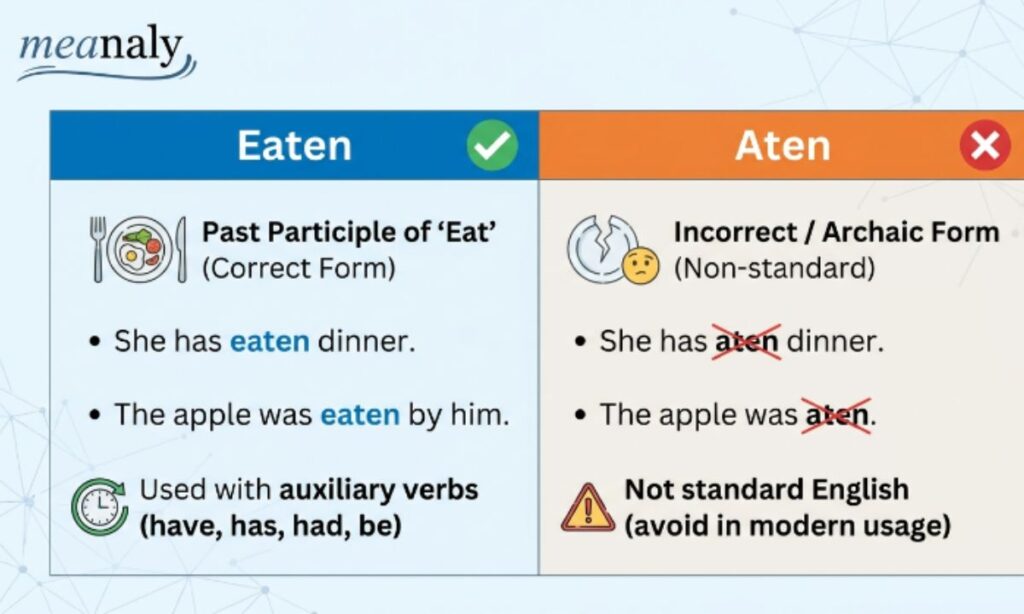
| Feature | Eaten | Aten |
| Correct spelling | ✅ Yes | ❌ No |
| Found in dictionaries | ✅ Yes | ❌ No |
| Used in British English | ✅ Yes | ❌ No |
| Used in American English | ✅ Yes | ❌ No |
| Common grammar mistake | — | ✅ Yes |
Frequently Asked Questions
What is the correct spelling, eaten or aten?
“Eaten” is correct; “aten” is not a recognized word in standard English.
Why is it eaten and not aten?
“Eat” is an irregular verb, and its past participle follows the “-en” pattern seen in words like “given” and “taken,” making “eaten” the correct form.
Is aten a real word in English?
No, “aten” does not appear in any English dictionary as a verb form or standard word.
What is the past participle of eat?
The past participle of “eat” is “eaten,” used with helping verbs like have, has, or had.
How do you use eaten in a sentence?
Use it after a helping verb, such as “I have eaten” or “The food was eaten quickly.”
Is there a difference between eaten and aten in British and American English?
No, “eaten” is the only correct form in both British and American English.
What is an easy way to remember the correct spelling of eaten?
Think of the pattern in “give → given” and “take → taken” — “eat → eaten” follows the same irregular verb structure.
Conclusion
The rule is simple and permanent: it’s always “eaten,” never “aten.” As the past participle of the irregular verb “eat,” it follows the same “-en” pattern used by verbs like “give” and “take,” and that doesn’t change across regions or writing styles.
Keep that pattern in mind, and you’ll never second-guess this one again – whether you’re finishing an essay, sending a text, or just checking your grammar before hitting send.

Hi , I’m a language researcher and content writer with 6+ years of experience in word meanings, slang, abbreviations, and internet terminology. He writes clear, accurate, and easy-to-understand articles to help readers quickly find reliable definitions and understand modern language with confidence.