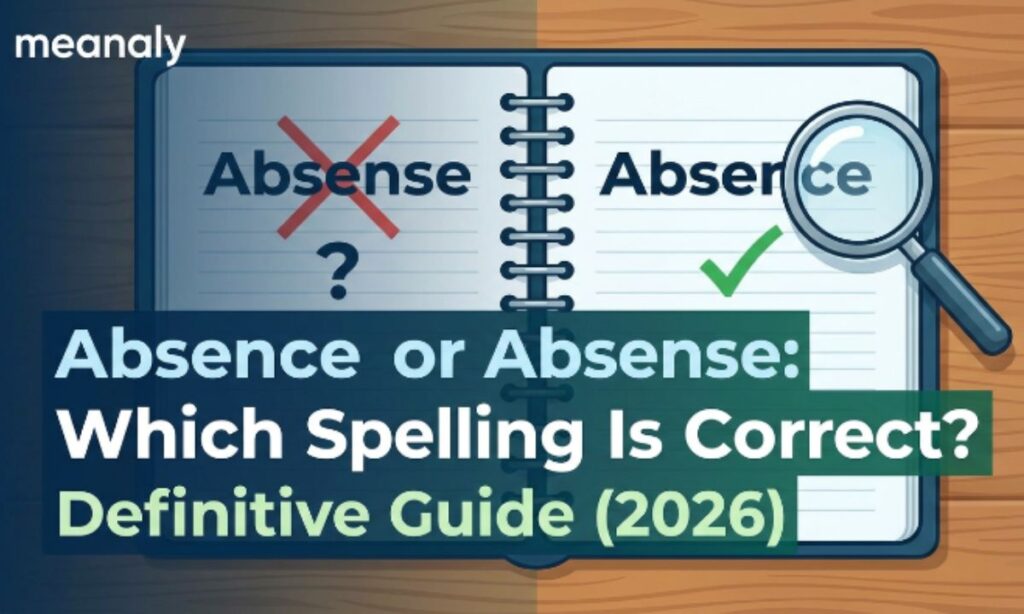
Typed “absense” in an email or school assignment and had that nagging feeling something looked off? You’re far from alone. Absence or absense is one of the most common spelling mixups in English, mostly because the word sounds like it should end in “-sense.” That one small swap – a “c” for an “s” – can make formal writing look careless.
This guide gives you the quick answer right away, then breaks down the word’s origin, British vs American usage, common mistakes, real examples, and simple tricks to help the correct spelling finally stick.
Absence or Absense :Quick Answer
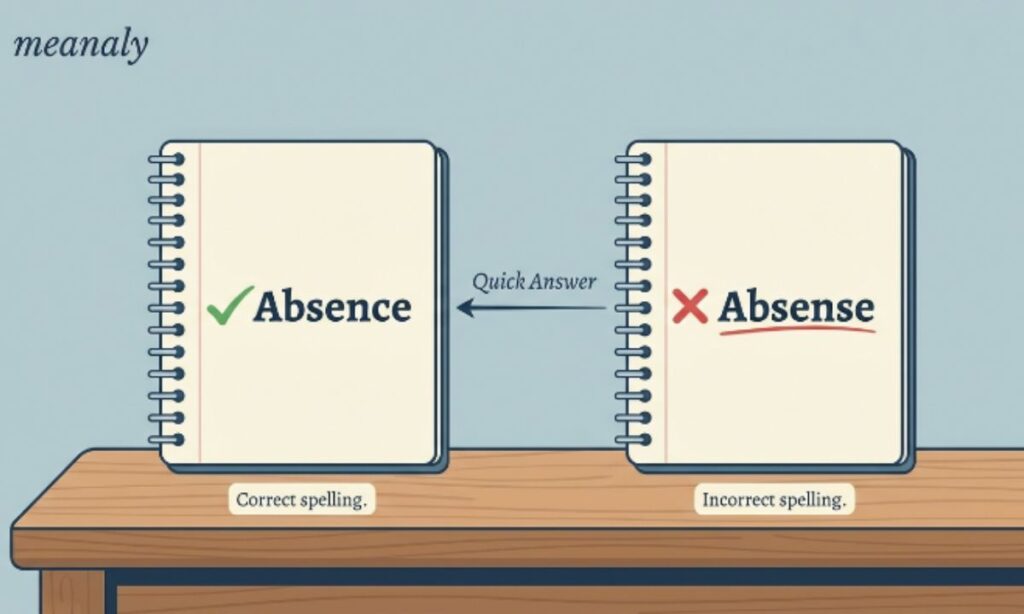
“Absence” is correct. “Absense” is a misspelling.
- ✅ Her absence from the meeting was noticed.
- ❌ Her absense from the meeting was noticed.
There’s no context – formal or casual – where “absense” is accepted.
The Origin of Absence or Absense

“Absence” traces back to the Latin word absentia, meaning “being away” or “not present.” It passed through Old French before settling into English with its current spelling, keeping the “-ence” ending along the way.
“Absense” has no such history. It didn’t develop from Latin, French, or any recognized root – it’s simply a phonetic error that happens because the word sounds like it should rhyme with “sense.”
British English vs American English Spelling
Some assume “absense” might be a regional variation – an American vs British thing, similar to color/colour. That’s not the case here.
| Region | Correct Spelling |
| British English | Absence |
| American English | Absence |
| Any other English variant | Absence |
Both varieties use the exact same spelling. There is no accepted regional alternative.
Which Spelling Should You Use?
Always use “absence.” A simple way to lock it in:
- Absence contains the letter “c” – just like presence.
- Think of the pair: presence and absence, science and existence – they all share the “-ence” pattern.
How To Spell Absence?
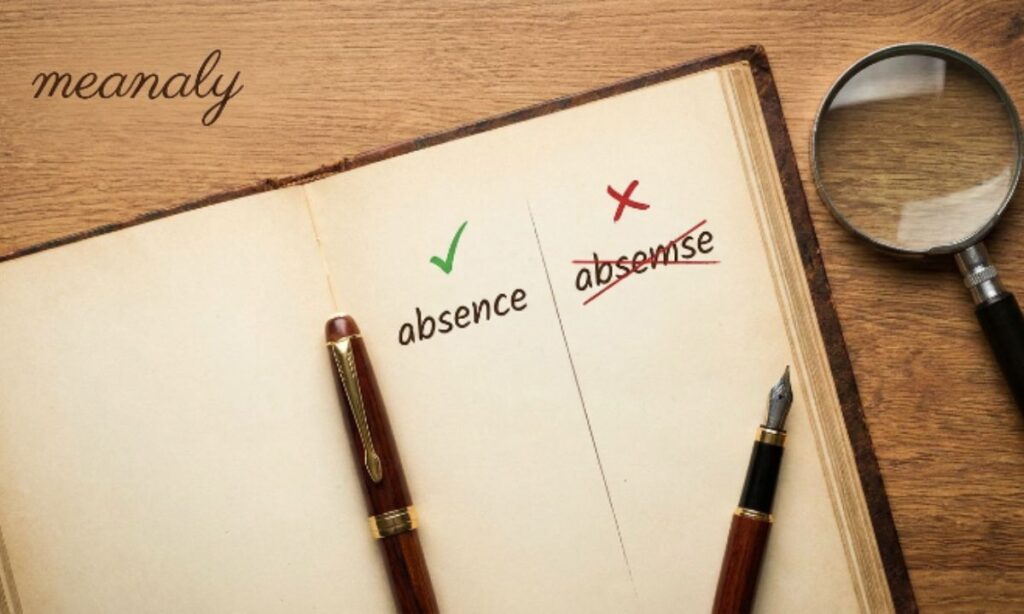
A-B-S-E-N-C-E.
- Break it down: Ab + sence
- The word “sense” is misleading – absence does not end in “-ense”
- Group it mentally with other “-ence” words: science, presence, existence, sentence
Plural Form of Absent
“Absent” is typically used as an adjective (“he was absent”) or a verb (“to absent oneself”), so it doesn’t usually take a plural form. The related noun, “absence,” does have a plural – “absences” – used when referring to multiple instances of being away:
- She had three unexcused absences this semester.
Absence or Absense Synonym
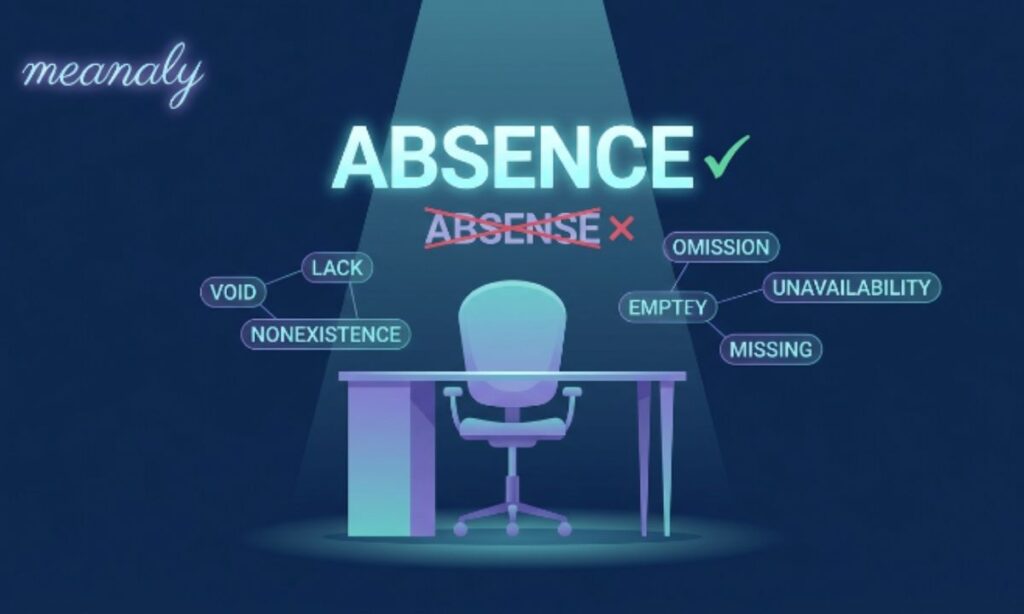
Common synonyms for absence include:
- Non-attendance
- Non-appearance
- Absenteeism
- Lack
- Nonexistence (in a broader sense)
Absence or Absense UK
In UK English, the spelling is identical to American usage: absence, with no regional variant. British dictionaries and style guides list only “absence” as correct.
Absence or Absent from School
In a school context, “absence” refers to a student missing a day (or days) of school, while “absent” describes the student’s status on that day:
- His absence was recorded by the school office.
- She was absent from class on Monday.
Absence Synonym
Beyond the general synonyms listed above, in more formal or written contexts, people also use terms like “truancy” (for unexcused school absence) or “leave” (for approved time away from work).
Absence Medical Term

In a medical context, “absence” can refer to a type of seizure – an absence seizure – a brief lapse in consciousness common in certain forms of epilepsy, especially in children. The spelling remains the same as the general usage.
Absence in French
The word traces back through Old French, and modern French still uses “absence” with the same spelling and a very similar meaning – the state of being away or not present.
Why Is This Mistake So Common?

- The word is pronounced with a soft sound that resembles “-sense”
- Similar-looking words like “sense,” “expense,” and “defense” end in “-ense,” creating pattern confusion
- Spellcheck doesn’t always catch it in casual typing or messaging apps
- Fast typing and autocorrect gaps let the error spread, especially online
Common Mistakes with absense vs absence
- Writing “absense” instead of “absence”
- Adding an extra letter: “abscence”
- Swapping the ending vowel: “absance”
- Assuming “absense” is a valid alternate spelling rather than an error
Absence or Absense in Everyday Examples
- His absence from work was unexpected.
- The teacher noted her absence in the register.
- Due to his frequent absence, he missed several lectures.
- The long absence of rain led to drought conditions.
- I supervised the rehearsal in the absence of the director.
Absence or Absense – Google Trends & Usage Data

A large share of searches for “absense” come from people actively checking their spelling before sending an email, submitting an assignment, or filling out a form – which is exactly why confusion around this word remains so persistent. Despite frequent searches, “absense” has never appeared as a recognized spelling in any major English dictionary.
Absence vs Absense: Comparison Table
| Feature | Absence | Absense |
| Correct spelling | ✅ Yes | ❌ No |
| Found in dictionaries | ✅ Yes | ❌ No |
| Used in British English | ✅ Yes | ❌ No |
| Used in American English | ✅ Yes | ❌ No |
| Common typing error | — | ✅ Yes |
Frequently Asked Questions
What is the correct spelling, absence or absense?
“Absence” is the correct spelling, with an “-ence” ending; “absense” is a common misspelling.
Why do people spell absence as absense?
People often spell it “absense” because of confusion with words like “expense” or “defense” that end in “-ense.”
Is absense a real word in English?
No, “absense” is not a recognized word in any English dictionary – it’s simply a misspelling of “absence.”
How do you spell absence correctly?
Absence is spelled A-B-S-E-N-C-E, ending in “-ence,” not “-ense.”
What does absence mean in English?
Absence means the state of being away or not present somewhere, such as missing work, school, or an event.
Is there a difference between absence and absense in British and American English?
No, there’s no regional difference – “absence” is the only correct spelling in both British and American English.
What is a simple trick to remember absence spelling?
A helpful trick is remembering “-ence” words often relate to a state or condition, like “absence,” “presence,” and “existence.”
Last Words
The rule is simple and permanent: it’s always “absence,” never “absense.” The word keeps its Latin-rooted “-ence” ending no matter the region, context, or how casually you’re writing.
Remember the link to “presence” and “science,” and you’ll never second-guess this spelling again.

Hi , I’m a language researcher and content writer with 6+ years of experience in word meanings, slang, abbreviations, and internet terminology. He writes clear, accurate, and easy-to-understand articles to help readers quickly find reliable definitions and understand modern language with confidence.