
Ever paused halfway through a sentence, unsure whether it’s “writing” or “writting”? You’re in good company. Since verbs like “sit” and “run” double their final letter before adding “-ing” (sitting, running), it feels natural to assume “write” should follow the same pattern. But English has a different rule here, and that one extra “t” trips up students, professionals, and native speakers alike.
This guide gives you the quick answer first, then breaks down where the word comes from, how British and American English treat it, common mistakes, real examples, and simple memory tricks so you never second-guess this spelling again.
Writing or Writting : Quick Answer
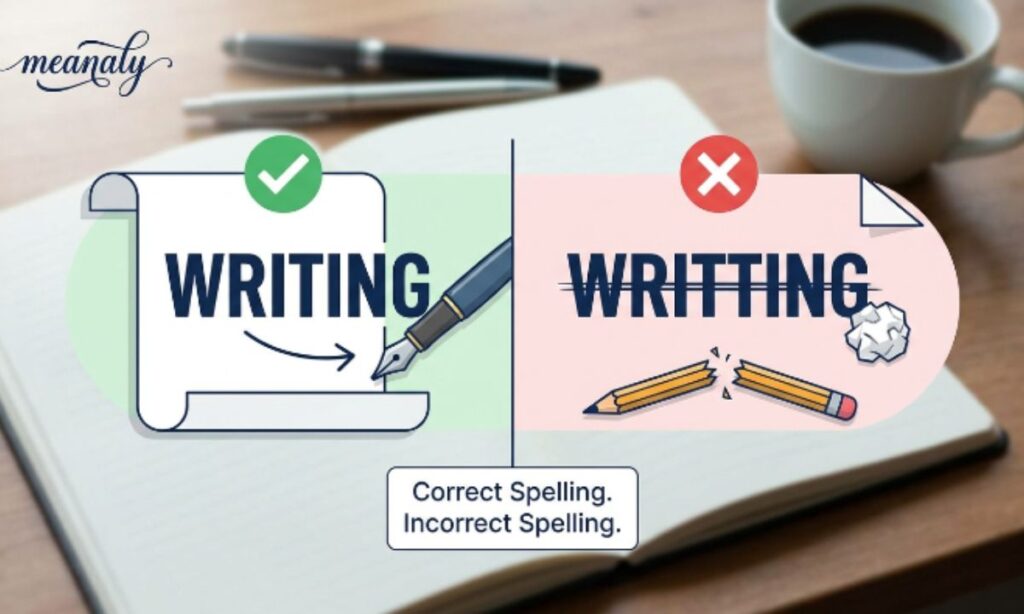
“Writing” is correct. “Writting” is a misspelling.
- ✅ She is writing a report for work.
- ❌ She is writting a report for work.
There’s no context : casual, formal, British, or American : where “writting” is accepted.
The Origin of Writing or Writting

The word “write” comes from the Old English writan, which originally meant to carve, scratch, or mark symbols : a reference to how early writing was physically etched into wood, stone, or metal. Over centuries, the meaning shifted to cover putting words on paper, but the spelling foundation stuck around.
When English forms the present participle of a verb ending in a silent “e,” the standard rule is to drop that “e” before adding “-ing.” That’s exactly what happens with “write” → “writing.” The double-“t” form never developed as a recognized variant, because the silent-e rule – not the consonant-doubling rule – is what applies here.
British English vs American English Spelling
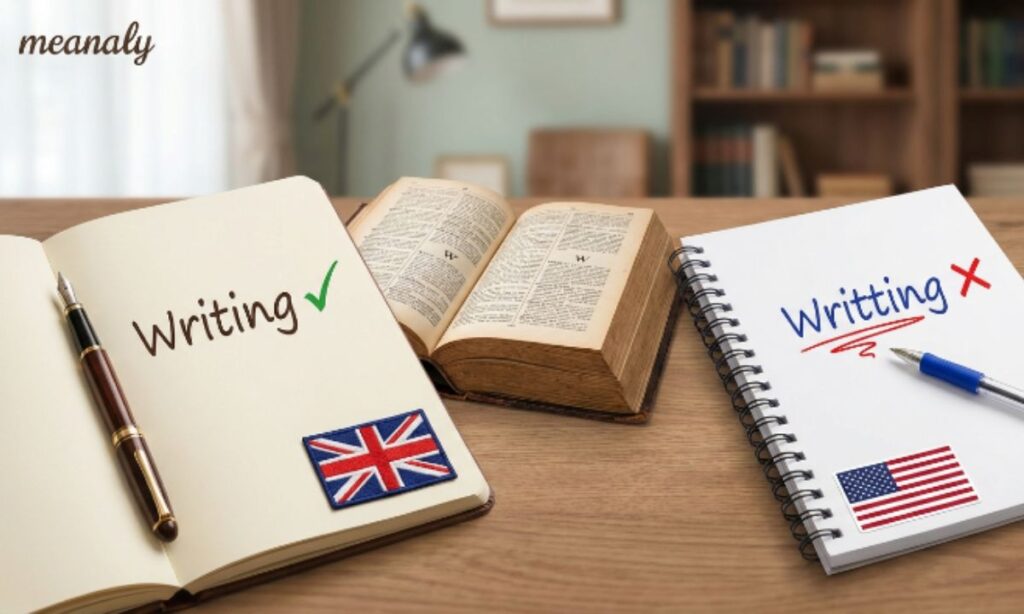
Some words split between regions – think color/colour or organize/organise. “Writing” isn’t one of them.
| Region | Correct Spelling |
| British English | Writing |
| American English | Writing |
| Any other English variant | Writing |
Both major English varieties use the exact same spelling, with no accepted regional alternative.
Which Spelling Should You Use?
Always use “writing.” A simple way to remember it:
- Write → drop the silent “e” → add “ing” → writing
- Writing has only one “t” — not two
How to Spell Writing ?
W-R-I-T-I-N-G.
- Start with “write”
- Remove the silent “e” at the end
- Add “-ing” directly onto “writ”
- Never double the “t” : that step only applies to short verbs like “sit” or “run,” not to verbs ending in a silent “e”
I am writing or writting
The correct form is always: “I am writing.”
- ✅ I am writing a letter to my teacher.
- ❌ I am writting a letter to my teacher.
This applies the same way in every tense that uses the “-ing” form – present continuous, past continuous, and future continuous all use “writing,” never “writting.”
Writing or Writting in english
In standard English, only “writing” is recognized -in dictionaries, grammar guides, and style manuals across every English-speaking region. “Writting” doesn’t appear as an accepted spelling anywhere in formal English.
Writing or Writting grammar

Grammatically, “writing” can function as:
- A gerund : “Writing improves your vocabulary.”
- Part of a continuous verb tense : “I am writing an email.”
- A noun referring to written work : “Her writing is clear and engaging.”
“Writting” has no grammatical role in English – it’s treated purely as a spelling error, not a valid word form.
Writing or writting examples
- ✅ He is writing a novel this year.
- ❌ He is writting a novel this year.
- ✅ Good writing takes practice.
- ❌ Good writting takes practice.
- ✅ They were writing notes during the lecture.
- ❌ They were writting notes during the lecture.
Writing or Writting exercises
Try correcting these sentences yourself:
- She is writting a birthday card. → She is writing a birthday card.
- My favorite hobby is writting short stories. → My favorite hobby is writing short stories.
- We were writting essays all afternoon. → We were writing essays all afternoon.
If you spotted “writing” as the fix in all three, you’ve got the rule down.
Common Mistakes with Writing or Writting

- Assuming “write” doubles its final consonant like “sit” or “run”
- Typing quickly and adding an extra “t” out of habit
- Copying incorrect spellings seen in casual social media comments
- Not noticing autocorrect hasn’t caught the error in a messaging app
Writing or Writting in Everyday Examples
- I enjoy writing in my journal every night.
- The teacher praised her writing skills.
- He spent the morning writing emails.
- Creative writing is her favorite subject.
- They are writing a proposal for the new project.
Writing or Writting : Google Trends & Usage Data

Search interest in “writing or writting” stays consistent year-round, with noticeable spikes during school terms, exam seasons, and professional writing periods, when students and writers are more likely to double-check spelling before submitting assignments or reports.
Despite steady search volume, “writting” has never appeared as a recognized spelling in any major English dictionary.
Comparison Table: Writing vs Writting
| Feature | Writing | Writting |
| Correct spelling | ✅ Yes | ❌ No |
| Found in dictionaries | ✅ Yes | ❌ No |
| Used in British English | ✅ Yes | ❌ No |
| Used in American English | ✅ Yes | ❌ No |
| Common typing/logic error | — | ✅ Yes |
Frequently Asked Questions
What is the correct spelling, writing or writting?
“Writing” is correct; “writting” is always a misspelling.
Why do people misspell writing as writting?
People often assume “write” doubles its final consonant like “sit” or “run,” but that rule doesn’t apply to verbs ending in a silent “e.”
Is writting a real word in English?
No, “writting” is not recognized in any English dictionary – it’s simply a spelling error.
How many T’s are in writing?
Writing has only one “t.”
What is the rule for adding -ing to write?
Drop the silent “e” at the end of “write” and add “-ing,” forming “writing.”
Is there a difference between writing and writting in British and American English?
No, “writing” is the only correct spelling in both British and American English.
How do you spell the word writing correctly?
It’s spelled W-R-I-T-I-N-G, with a single “t.”
Conclusion
The rule here is simple and permanent: it’s always “writing,” never “writting.” English drops the silent “e” from “write” before adding “-ing,” and the consonant-doubling rule that applies to words like “sit” or “run” simply doesn’t apply here.
Remember the one-“t” trick, and you’ll spell it correctly every time — in emails, essays, and everything in between.

Hi , I’m a language researcher and content writer with 6+ years of experience in word meanings, slang, abbreviations, and internet terminology. He writes clear, accurate, and easy-to-understand articles to help readers quickly find reliable definitions and understand modern language with confidence.